Showing posts with label gender/sexuality. Show all posts

Monday, November 25, 2019

Genji's Male Dominance


            While reading this piece of literature, I become very sickened in the way that Genji used women to satisfy his need for dominance. I spent some time watching the R. Kelly documentary tapes this past summer and Genji’s actions show many similarities to R. Kelly’s actions with women. If R. Kelly’s story is not familiar to you, it is a very long and uncomfortable story. R. Kelly is a famous musical artist that was known for having interest in younger women or underage women. Younger women interested him because of their innocence and his ability to control them easier than a mature adult. R. Kelly would hold these girls in his house, and they would not be allowed to even go to the bathroom without asking him first. Theorists who have been following him believe that he controls these girls until they become almost like a pet to him. The documentary is very interesting and definitely a must watch if you enjoy investigative shows.
If you haven’t caught onto where I’m going with Genji, let me explain. Genji showed interest in more innocent or childlike women. The story validates that when it says, “Something childlike in her fright brought a smile to his lips” (p. 1483). Genji is intrigued in the innocence and we could even say the vulnerability of this woman to be influenced by him. Genji was a married man and so was R. Kelly, but it seems like this infidelity was acceptable for Genji compared to the negative traits it has today. We discussed how common it was for married and powerful men to have affairs with multiple other women. These women threw themselves at Genji because he is who he is. This is a parallel to R. Kelly’s story because the same happened for him. These younger girls or naive young women would throw themselves at him because of his money and fame. A lot of the time R. Kelly would promise musical opportunities to these women and that would make them even more inclined to stick with him. The “player” personality of Genji is something that we often find in wealthy and powerful people today. Although Genji is not at the extreme level as R. Kelly, it is hard not to see the similar tendencies these men had with taking full advantage of who they were.

What were your opinions on Genji and his lovers? Did you think that he was a good lover or a toxic lover?

Image result for the tale of genjiImage result for r kelly


Wednesday, November 6, 2019

Justice for the women


In the story, The Book of the City of the Ladies, we see a different world through the narration.  She is lead to create an entire city by three women who represent Justice, Rectitude, and Reason. This city that is established protects women from the rude comments and actions of male counterparts.  Christine goes through each level and learns all different tools that aid in her learning her worth.  The worth is so important and shows that she should always be valued as a woman. A few questions..

  1. Should she have listened and built the city? Or left well enough alone?
  2. Is there more to the levels than what she accomplishes?
  3. Should we see more of what happens after she completes the city?

Friday, November 1, 2019

Cunning Women and Their Entrapments of Men! MWAAHAHA

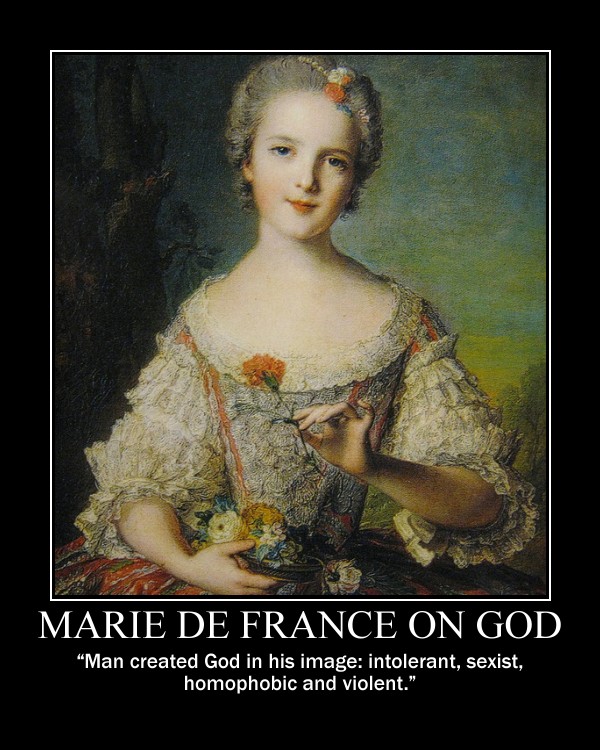
Marie De France
            
Image result for marie de france memes
(I saw this meme and thought that after all the we have read, it was pretty relevant lol!)


           Women in the majority of the stories that we have read have had to be cunning and calculating to ensure their survival. However, many of these women I feel entrap their male counterparts out of spite such as Guinevere does to Launfal because he turns her down and blatantly calls her ugly. I would like to focus on the women in Sir Launfal.

Promiscuous Queens seems to be a common thread through these stories. I kind of chuckle at the predicaments these women are able to entrap these men in. Guinevere blatantly asks Launfal to sleep with her, and for him to give her his love, and when he refuses, not only does that bait him into spilling his guts about his much fairer lady-friend, but also Guinevere takes this horribly and runs to Arthur. Of course Arthur wants Launfal’s head; he just called his wife ugly! This puts Launfal into even more of a pickle, if that’s even possible, because now Launfal is being ordered to identify his lover and we all know how his story ends.

The women in these stories are not only cunning and mischievous, but also educators of sorts. They help facilitate life lessons being learned by their male counterparts. Launfal learns to not only have a filter, especially when what you have to say may not be the nicest thing in the world, even though it may be true; he also learns that sometimes sugar coating, and kissing up to someone is better than being put on death row due to your inability to filter your verbal diarrhea. 

So… my questions to you folks are:

1)  Do you agree with my findings, and if not…PLEASE feel free to disagree!! I want your gut reactions as well as your reaction after taking a second to process. Have fun with this!! You can give examples of your own if you so choose!
2)  On the topic of sugar coating, those of you that know me well will know that sugar coating is not one my strong suites. However, do you think there is a time and place to sugar coat things and/or be more mindful of your words in Launfal’s case? Or do you think that Launfal was totally justified in saying what he said even though the repercussions of his actions were quite extreme?

3)  If you were Launfal, would you have done anything differently, and if so what would you have done differently? Keep in mind, we do know the ending…so you can use that to your advantage… i.e. would you ask someone to be standing around when Guinevere comes on to you? Would you expose her, and if so what would HER repercussions be? (Again have fun with this! Be creative and make your own twists and turns! I’m excited to see what you come up with!!!)

Saturday, September 14, 2019

Musings on This Week's Blog Conversations

Well, the Week 1 posts made for a promising start for our blog. Good seed posts and pretty vigorous discussion, too. I’m looking forward to Week 2’s conversations…

Naturally, I discerned a few main themes among this week’s various posts and comments, which I would like to address, so here goes…

GODS & HUMANS
It’s an all-too-human tendency to judge the behavior of the gods by our own contemporary sense of morality. We can’t help from doing this (and actually should do this as readers, because it helps us clarify our own principles), but it can also lead us to misdiagnose sometimes.


Gods and goddesses are not mortal, nor are they shaped by the psychological burdens that mortality confers. They may be human-like (we are typically made in their image, after all), but they are not human. And they have responsibilities. Each god and goddess typically has a charge or suite of charges (rivers, the heavens, crops, war, fertility, the Sun and the passage of time, death, knowledge, justice, winds, what-have-you). It’s their job to keep that facet of creation running and in good order. If they neglect those responsibilities, the world gets out of whack. People and animals, even the gods themselves, can suffer.

Inanna
This is relevant to Inanna because she is the goddess of a suite of related domains: fertility, sexuality, crops, and abundance, among others. Perhaps it was hubris (something we are more forgiving of in a man, by the way, than in a woman, where it more often translates to “selfishness”) that she acted on her wild notion to experience the underworld. But when she died there—had she remained there, dead forever—what would have happened to the world? No Spring, no offspring, no crops, no abundance, no sacrifices of meat and drink to the gods. The world dying and out of whack, winter without end.

That’s why so much effort was put into Inanna’s resurrection and retrieval from the Underworld. But even so, her return is achieved only through compromise: she is free to leave, but only if someone takes her place.

Ereshkigal
That non-negotiable “deal” sets the stage for Inanna’s desperate search to find a hostage to trade for her release. It’s a terrible choice, yet she must make it. But who? Ninshubur? Unthinkable. Ninshubur, her protector and enforcer, has been with her since she was a girl, and she relies on her special powers. Her own sons? How could a mother make that choice? She can’t bear the thought. But who else could be close enough that their sacrifice would hurt? It can’t be some luckless passerby who means nothing to her. (For one thing, I doubt that a mortal could survive the horror of hell for one day, much less the decreed term of half a year.) No, it pretty much has to be a god or demigod—and that narrows the choice down pretty drastically: Dumuzi, poor bastard. Didn’t help that he doesn’t seem to have noticed she was gone…

GILGAMESH & ENKIDU
How many movies have we seen where two macho hombres square off in a bar fight, beat the crap out of each other for an hour or so, then suddenly start laughing their heads off, bond over it, and—boom—BFFs forever? (Yeah I know, Department of Redundancy Department, but rhythmically, the “forever” was required…) It’s a Y-chromosome trope, from time immemorial. You can find parallel X-chromosome examples (usually without the brawling) in literature, life, and film as well…

SEXUALITY
Sexuality is a major theme in Mesopotamian literature (let’s face it, all literatures, even if driven underground by taboo). It is certainly plain that sexual matters had no need of being whispered behind drawn curtains or disguised inside elaborate metaphors. (The line between metaphor and reality in the Inanna hymns is vanishingly small...)

Inanna
It is also an important topic for American readers to confront, because of the stark contrast between the treatment of sexuality in Sumerian and Akkadian literature and its treatment in the literature of the three great Abrahamic religions—Judaism, Christianity, Islam—where matters of sexuality are often severely and substantially repressed. Christianity, especially, has taken this suppression to great lengths. This rejection of the flesh and suspicion of earthly pleasures, which is our troubled Western inheritance from that tradition, can warp our initial responses to the Mesopotamian materials. American readers may experience something almost like shock at the openness of sex and sexuality in these religious and cosmological works—so different in this regard from our own religious texts! Such shock can be an impediment to understanding and appreciation...

INANNA’S LIFE HISTORY
Many people commented Inanna’s character and possible character flaws, contrasting her more loving earlier nature with the more cruel persona of her resurrection and return. There is a change in her nature as she matures from adolescent to young woman, from lover to mother, from queen to goddess.
Inanna

That’s what I find so extraordinary about the Inanna hymn cycle (especially as Diane Wolkstein has chosen and arranged the disparate fragments into a single, chronological narrative): we see Inanna in the round, through time, in a fullness rarely seen for a female character in this mythic genre. (There are few to no comparable longitudinal portrayals of women in ancient Greek or Biblical or Egyptian literature—at least that I am aware of…) No, we must wait for the development of the novel for that kind of character development…

It’s easy to see the Ishtar of Gilgamesh as simply a continuation of Inanna as we last see her in the Hymns. Dumuzi was just the first of her many conquests, none of which ended well for the chosen one. Ishtar is indeed an organic continuation of the goddess Inanna by another name, but remember: Inanna and Ishtar are separated from each other by culture (Sumerian vs. Old Babylonian), language (Sumerian vs. Akkadian), and some 800 years of history (2000 BCE vs. 1200 BCE). Over that time-span, though retaining many of her earlier Sumerian traditions and attributes, Inanna has been passed through the long filter of a new language, changing cultures, and complex histories—somewhere along the line adding War Goddess to her portfolio—to emerge as the wrathful Ishtar whom Enkidu smacks with the Bull of Heaven’s thigh.

In short, it’s not entirely fair to treat Inanna and Ishtar as the “same” character…

Monday, September 9, 2019

Sexuality in Mesopotamia


Sex.  The basis of our society and repopulation. but for many of you us in western society sex is regarded as something shame-full and not to be talked about.  But why is this the way it is? For something so important to every species on earth, and as one of the few species who do it specifically for pleasure why is it such a taboo subject?

In Mesopotamian literature, it is clear that sex is freely talked about and accepted. Inanna, for instance, is so wooed by her own Vulva that she stopped and gazed at it in wonder. With the Holy Me’s Inanna was gifted with the art of kissing the Phallus. In both the stories of Inanna and the Epic of Gilgamesh there are references to temple harlots. Priestesses who are regularly engaged in ritualistic sex for the main pantheon of gods. In Gilgamesh, there are even examples off gay relationships that are common and accepted in the day to day of heroes. Even in the Iliad, references to sex and keeping women besides wives for purposes of consummating is seen to be the norm by the Greeks.

         Why then, if these things are so common in the origins of many peoples, if not most, Is it so taboo in our current day to day society? How was sex changed from something to be proud of to something to keep closed behind doors?