Showing posts with label Aeneid. Show all posts

Tuesday, October 8, 2019

Dido and Aeneas: Could They Have Had It All?

When I was reading through Virgil's The Aeneid, the one dynamic that really interested me the most was the relationship between Aeneas and Dido.  With the help of Aeneas' mother (Venus) and Cupid, disguised as Aeneas' son, the two Roman "love" gods helped Dido fall head over heals for Aeneas of Troy.  Much like Penelope and Odysseus, I can't help but think that Dido and Aeneas were almost "perfect" for one another.  Both Aeneas and Dido had similar life experiences that make them balance out one another in their interactions together.

Back in Tyre, Dido's husband was killed by her brother, causing her to flee to, what is now, Carthage, to save her life.  Aeneas tried to get his wife, son, and father out of war-torn Troy, but, unfortunately, Aeneas' wife perished and returned to Aeneas as a ghost, telling him to flee from Troy, hence, leads to Aeneas' and his men's ships washing up at the shores of Carthage.  In other words, Dido and Aeneas both had to flee their home-lands, lost their significant others, and had to start all over with their lives by moving their kingdoms.  Dido developed her own kingdom, while it is Aeneas' destiny to move Troy to Italy.

Part of me wishes that Aeneas would have stayed with Dido, since I think they had such a good connection, due to their similar unfortunate circumstances.  However, The Aeneid wouldn't be The Aeneid if Aeneas didn't obey the gods and followed his destiny; to move the new Troy to Italy.  I swear, someone needs to make a re-telling of a different ending of The Aeneid if Aeneas didn't listen to Mercury to leave Dido.  I would have liked to see what would have happened if Aeneas stayed and married Dido, because Aeneas seemed to have fallen for Dido, even though Dido was under the spell of Venus and Cupid.

Here are some questions to consider:
1.) Is it all a coincidence that Dido and Aeneas had similar misfortunes, or do you think Virgil did this on purpose so that we (the readers) can relate or understand why Dido would be attracted to Aeneas?

2.) Do you think Aeneas and Dido would have been a great couple?  Explain.  I would love to know you guys' opinions. 

3.) What would you think would have happened if Aeneas had stayed with Dido?

What the Hector?

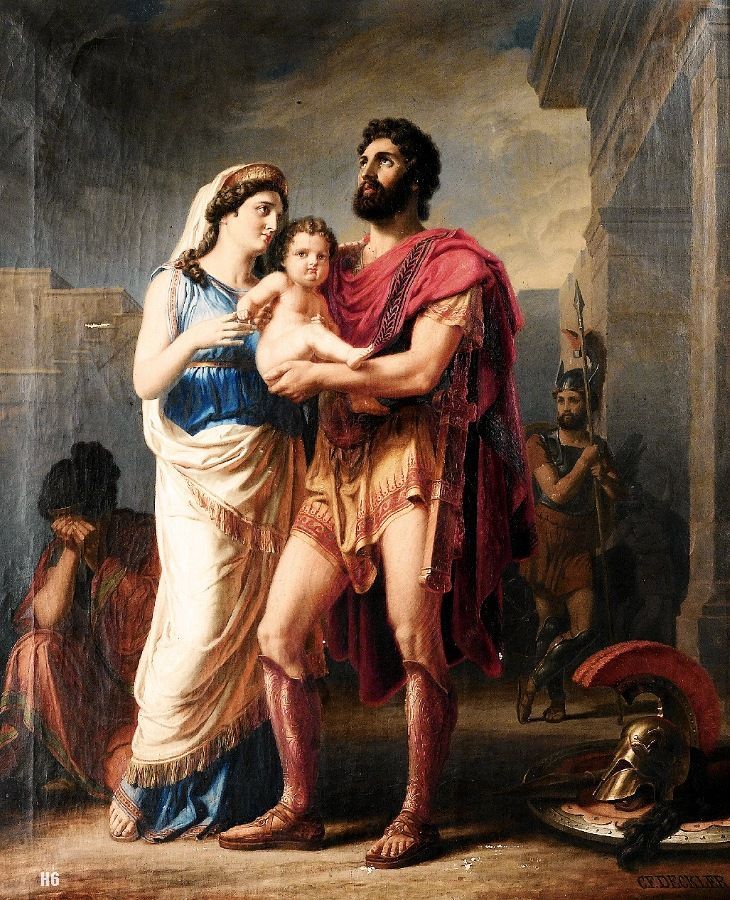
We have already discussed the similarities between Aeneas and Hector in class but I wanted to beat the Trojan horse a little bit more. To start with, the Greeks do not tend to demonize their enemies in their stories and, as a result, make themselves look bad in some aspects - a phenomenon that Virgil both takes advantage of and takes care to avoid as a similar trait within his own work. The Greek stories spend more time with the Greek heroes, as one would expect. Since they have more exposure, they also have more flaws, increasing sympathy for the family man Hector from those of us not involved in an ongoing rivalry with the Trojans/future Romans. This firmly establishes Hector as a Trojan family man and war hero, while Achilles, Agamemnon, and Odysseus must all prove themselves again and again - and face consequences when they succumb to their hubris. Hector dies because of Zeus's scale and Athena's trickery, not any fault of his own. Aeneas is instantly designed to become the new Hector: a Trojan family man and war hero, better than the Greeks in every way. As I already said, Virgil does not replicate the Greek tendency to let enemies remain enemies rather than demons. Aeneas passes every test that the Greek heroes struggled with - similar to Hector, who had to face Achilles, Odysseus, and Agamemnon together (excepting Achilles's tantrum) in war, while we hear little about any other legendary Trojan heroes to help him in what seems to be a three on one major player battle. Aeneas also requires divine intervention to move him along toward his fate. While in Hector's case the fated destination is death, Zeus and Athena make sure it happens. Aeneas requires Jove to scare him on toward Italy and the establishment of Rome. 
Image result for trojan hector
Hector, Andromache, and Astyanax (Son)
Related image
Aeneas, Creusa (Wife), Anchises (Father), and Ascanius (Son)

Monday, September 30, 2019

Troy Story 2: Electric Boogaloo

When we talk about the works of Homer, Aeschylus, and Virgil, we usually talk about them in the context of individual books. But when we pan out and view them from a distance, it becomes clear that each individual book is part of the same story, the difference between them being the context in which we view the story.

The Iliad begins with an up close and personal view of the beginning of the rift between Achilles and Agamemnon: A rift that moved gods and men and turned the tide of the war. We're getting to see the Trojan war, yes, but we're viewing it through the context of Achilles' actions and the effect he had on it.

Next, the Odyssey. As we follow Telemachus and Odysseus around the Mediterranean, we learn through their eyes and ears more about this world and the characters in it. In Agamemnon's part of the Oresteia, we find more clues. The tape rewinds, and we expound upon a part of the narrative that had been glossed over in the last story.

Hundreds of years later, Virgil dusts off the old epic and gets out paper and pen. This time we rewind almost back to the beginning and we see the aftermath of Troy from the perspective of Aeneas and the Trojans.


When else in history has this phenomenon occurred? What other examples do we have of different authors and different mediums joining together through time and space to create a single narrative that has imprinted itself into our culture? I think it’s special how The Iliad, The Odyssey, The Oresteia, and The Aeneid form Voltron an interconnected web of people and events that make up a part of a much larger story.