We have already discussed the similarities between Aeneas and Hector in class but I wanted to beat the Trojan horse a little bit more. To start with, the Greeks do not tend to demonize their enemies in their stories and, as a result, make themselves look bad in some aspects - a phenomenon that Virgil both takes advantage of and takes care to avoid as a similar trait within his own work. The Greek stories spend more time with the Greek heroes, as one would expect. Since they have more exposure, they also have more flaws, increasing sympathy for the family man Hector from those of us not involved in an ongoing rivalry with the Trojans/future Romans. This firmly establishes Hector as a Trojan family man and war hero, while Achilles, Agamemnon, and Odysseus must all prove themselves again and again - and face consequences when they succumb to their hubris. Hector dies because of Zeus's scale and Athena's trickery, not any fault of his own. Aeneas is instantly designed to become the new Hector: a Trojan family man and war hero, better than the Greeks in every way. As I already said, Virgil does not replicate the Greek tendency to let enemies remain enemies rather than demons. Aeneas passes every test that the Greek heroes struggled with - similar to Hector, who had to face Achilles, Odysseus, and Agamemnon together (excepting Achilles's tantrum) in war, while we hear little about any other legendary Trojan heroes to help him in what seems to be a three on one major player battle. Aeneas also requires divine intervention to move him along toward his fate. While in Hector's case the fated destination is death, Zeus and Athena make sure it happens. Aeneas requires Jove to scare him on toward Italy and the establishment of Rome.
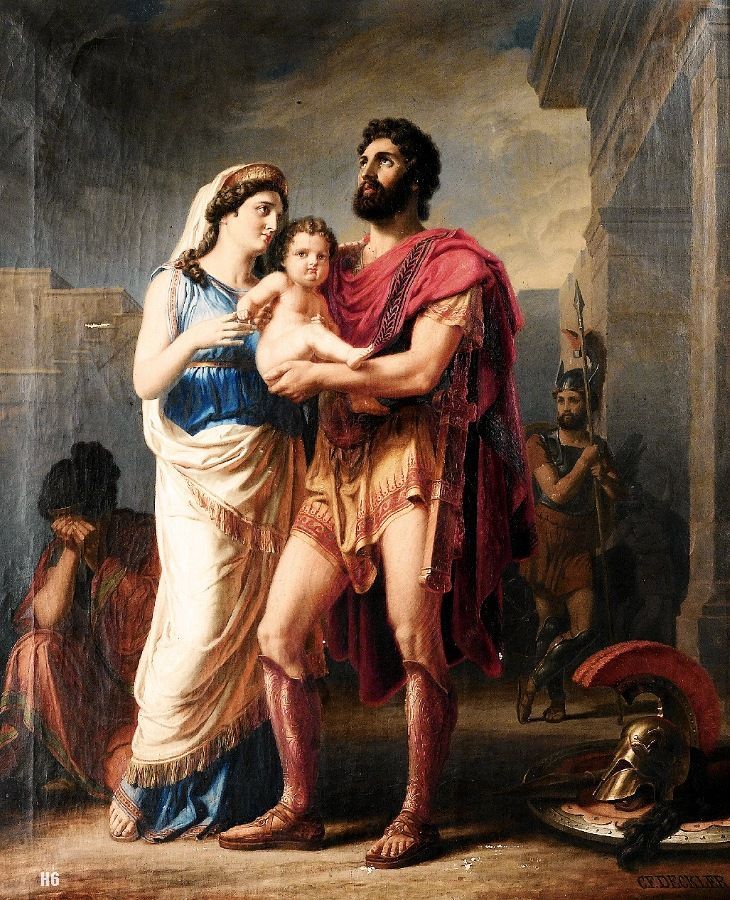 |
| Hector, Andromache, and Astyanax (Son) |
 |
| Aeneas, Creusa (Wife), Anchises (Father), and Ascanius (Son) |

