Showing posts with label heroes. Show all posts

Monday, November 25, 2019

Some Thoughts on Genji


When discussing the Tale of Genji in class, it seemed like a lot of people disliked it. I on the other hand found it more interesting and unique than a lot of other things we’ve been reading recently. Several people found it hard to follow, whereas I found it easier to follow than some previous readings. The fact that we’ve only been given such a small excerpt made me more curious about the rest of the book and want to know more about what happens. I also was completely unfamiliar with any Japanese literature or history, so that made it more intriguing as well.

For those who disliked the reading: were there any aspects about it that you did like or find interesting? Whether having to do with the story itself, use of poetry throughout, or what we learned about Lady Murasaki, for example the fact that she managed to learn to write with Chinese characters in a time when women were forbidden from doing so. Or even some of the art that we were shown in class. I personally found it to be really beautiful.


My second question for everyone is: why do you imagine that this particular chapter about the Evening Faces was the one chosen for our textbook? In what ways do you think the events or descriptions in this chapter might give us a good idea or understanding of the book as a whole?

Lastly, my final question is: since this takes place in a time where heroism was not about skills in battle or any of the other stereotypical “heroic” qualities that we’ve gotten used to, what qualities or actions make or don’t make Genji a hero in this tale, besides just being the son of an emperor? And what evidence points to those things being seen as heroic during this period?

Tuesday, November 19, 2019

A Lie of Omission

Bamsi Beyrek’s story is both interesting and really crazy. Several times throughout the story, Bamsi proves himself to be relatively observant but does not say anything about his observations – he keeps his head down and his mouth shut. In exchange for saving some merchants, he asks for the horse, club, and bow that they are supposed to bring back to his father as gifts for him. While they are willing to do so, if unhappy about it, Bamsi allows them to bring the items to him so that they will not get in trouble for losing them and so that his father can give them to him. Instead of claiming what they technically owe him and earning his name now that he has killed men, he allows himself to remain nameless instead of shaming the merchants.
               Bamsi also later conceals his encounter from his father when asked what kind of woman he wishes to marry. Rather than say that he met his betrothed in the woods or use her name when describing her, he allows his father to interpret his description into Banu Chichek. While marrying her certainly has its own repercussions (her brother’s overprotectiveness, specifically), I am focusing more specifically on the potential repercussions of Bamsi’s manipulation of his father. Are Bamsi’s omissions to his father more likely to have beneficial or damaging consequences, and why?
Related image

Tuesday, October 8, 2019

Dido and Aeneas: Could They Have Had It All?

When I was reading through Virgil's The Aeneid, the one dynamic that really interested me the most was the relationship between Aeneas and Dido.  With the help of Aeneas' mother (Venus) and Cupid, disguised as Aeneas' son, the two Roman "love" gods helped Dido fall head over heals for Aeneas of Troy.  Much like Penelope and Odysseus, I can't help but think that Dido and Aeneas were almost "perfect" for one another.  Both Aeneas and Dido had similar life experiences that make them balance out one another in their interactions together.

Back in Tyre, Dido's husband was killed by her brother, causing her to flee to, what is now, Carthage, to save her life.  Aeneas tried to get his wife, son, and father out of war-torn Troy, but, unfortunately, Aeneas' wife perished and returned to Aeneas as a ghost, telling him to flee from Troy, hence, leads to Aeneas' and his men's ships washing up at the shores of Carthage.  In other words, Dido and Aeneas both had to flee their home-lands, lost their significant others, and had to start all over with their lives by moving their kingdoms.  Dido developed her own kingdom, while it is Aeneas' destiny to move Troy to Italy.

Part of me wishes that Aeneas would have stayed with Dido, since I think they had such a good connection, due to their similar unfortunate circumstances.  However, The Aeneid wouldn't be The Aeneid if Aeneas didn't obey the gods and followed his destiny; to move the new Troy to Italy.  I swear, someone needs to make a re-telling of a different ending of The Aeneid if Aeneas didn't listen to Mercury to leave Dido.  I would have liked to see what would have happened if Aeneas stayed and married Dido, because Aeneas seemed to have fallen for Dido, even though Dido was under the spell of Venus and Cupid.

Here are some questions to consider:
1.) Is it all a coincidence that Dido and Aeneas had similar misfortunes, or do you think Virgil did this on purpose so that we (the readers) can relate or understand why Dido would be attracted to Aeneas?

2.) Do you think Aeneas and Dido would have been a great couple?  Explain.  I would love to know you guys' opinions. 

3.) What would you think would have happened if Aeneas had stayed with Dido?

What the Hector?

We have already discussed the similarities between Aeneas and Hector in class but I wanted to beat the Trojan horse a little bit more. To start with, the Greeks do not tend to demonize their enemies in their stories and, as a result, make themselves look bad in some aspects - a phenomenon that Virgil both takes advantage of and takes care to avoid as a similar trait within his own work. The Greek stories spend more time with the Greek heroes, as one would expect. Since they have more exposure, they also have more flaws, increasing sympathy for the family man Hector from those of us not involved in an ongoing rivalry with the Trojans/future Romans. This firmly establishes Hector as a Trojan family man and war hero, while Achilles, Agamemnon, and Odysseus must all prove themselves again and again - and face consequences when they succumb to their hubris. Hector dies because of Zeus's scale and Athena's trickery, not any fault of his own. Aeneas is instantly designed to become the new Hector: a Trojan family man and war hero, better than the Greeks in every way. As I already said, Virgil does not replicate the Greek tendency to let enemies remain enemies rather than demons. Aeneas passes every test that the Greek heroes struggled with - similar to Hector, who had to face Achilles, Odysseus, and Agamemnon together (excepting Achilles's tantrum) in war, while we hear little about any other legendary Trojan heroes to help him in what seems to be a three on one major player battle. Aeneas also requires divine intervention to move him along toward his fate. While in Hector's case the fated destination is death, Zeus and Athena make sure it happens. Aeneas requires Jove to scare him on toward Italy and the establishment of Rome. 
Image result for trojan hector
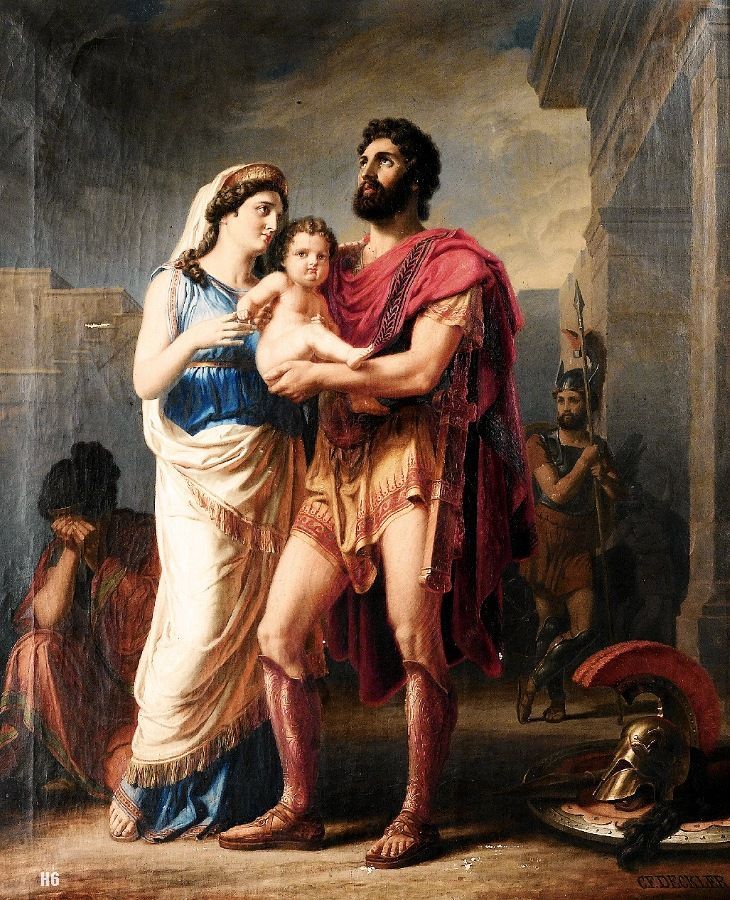
Hector, Andromache, and Astyanax (Son)
Related image
Aeneas, Creusa (Wife), Anchises (Father), and Ascanius (Son)

Aeneas vs. Odysseus

While reading The Aeneid  I noticed a number of similarities and parallels that Virgil made to Odysseus  in The Odyssey. From the very beginning Virgil creates the theme of how heroic Aeneas is, just as Odysseus was described from the beginning of The Odyssey. Not to mention the similar details between the adventures of both Aeneas and Odysseus.

It didn't take long though to realize that there are a significant amount of differences as well. Odysseus is known for his want to explore and to satisfy his interest in the unknown. He purposely involves himself in conflict for the sole purpose of being curious. He could have avoided conflict with Polyphemus if he wouldn't have been so hungry for adventure.


On the other hand Aeneas' intentions are purely on what is best for his people and family. He sacrifices the peaceful, happy life he knows he could have for his public duty to his people. While Odysseus' priority did not seem to be his men, shows as he came back without them, Aeneas fights for others, and to create a future for them. He is driven for others benefits, not his own personal desires.

Saturday, September 28, 2019

Ruminations on This Week's Conversation

On the gods…

There were some interesting posts and comments about the role of the gods on the blog this week. One of the more interesting threads questioned how much credit for heroism was actually due to Odysseus and Achilles, given how much help they receive from their godly champions. (When you think of it, shouldn’t we rank Hector’s fame actually higher, given that he achieved his feats largely despite the ill-favor of key gods and goddesses?)

Maybe the way to look at it is through our own experience of bravery, luck, and heroism. When something profound or amazing happens, what do we say? You win the lottery: God was smiling on me today. A child survives a deadly illness: Her guardian angel never left her side. Someone survives a should-have-been fatal crash: Jesus took the wheel. Did they? Well, maybe. But did anyone actually see that? Or was it luck, resilience, quick reflexes? Maybe yes, maybe no. It is an ancient human response to extraordinary fortune or acts of prowess in defeat or victory to see an unseen hand in those events.

But here's the key point: Do we think any less of the bravery or strength or persistence of these hometown heroes and survivors because we suspect they had an angel on their team? I think it was no more different for the Greeks of Homer's time than it is for us in our modern time.


The question of Odysseus’ culpability in the loss of his men…

So many of you have voiced exasperation at Odysseus as a leader—maybe especially for his seeming utter inability to bypass any island or country his ships come across in their voyage home to Ithaca—that I thought it made sense to address this issue here. And you are not wrong about it! Odysseus’ behavior certainly comports with the personality traits for which he is famous: an abiding curiosity about the world, coupled with a deep-seated drive to know all that can be known and experience all that can be experienced. But: that’s not all there is to it.

Knowledge of the shores and islands and waters of the Mediterranean is  indispensable for the sailor. And the most reliable knowledge is that gained from personal observation and exploration. Let’s remember, too, that ships had to stop frequently on long journeys to take on fresh water and replenish food supplies. Most of the times when Odysseus and his men make landfall, it is because they are damaged, having been battered by some storm and in need maintenance, or hungry and in dire need of replenishing their stores. So it’s not all for the adventure of new lands and peoples, though it's that, too...


Cheating on Penelope?

Well yeah, but. Do not underestimate just how formidable a demigoddess can be, either in her powers of seduction or in her powers to completely mess you up long-term if you cross her. No less than male gods, they are dangerous, unpredictable beings, however beautiful. Odysseus’ bondage to Círcë and later Calýpso is not just sexual: his crew are essentially hostages, whose lives depend on how happy he makes his beguiling captors. Only more important and powerful gods, intervening at Athena's request, can finally break their spell and set him free.

I'm not saying it was exactly torture for poor Odysseus, but, in the end, as we see him weeping beside the seashore on Calýpso's fragrant, wafty isle, we realize the end he has reached: these goddesses are not his wife, and their islands are not his home...

Sunday, September 22, 2019

Achilles versus Hector: Who Really Wins?


Whenever you read and/or analyze The Iliad, one of the biggest and most prevalent points to talk about is the relationship formed between Achilles and Hector.  Though most would argue that Achilles is our hero and protagonist, I am here to ask the question: is he really?

When you look at these two characters, you will find that they have a lot more in common that what one would initially think.  They are both leaders, strong willed, and want to lead their armies to success. Though their differences are far more evident, they ultimately want the same things.  So what makes one a hero over the other?

Hector is far more mature than Achilles, and leads his men with a sharp mind.  He is courageous and has a lot at stake. He is not only fighting for his kingdom, but for his family and companions as well.  He seems to keep everyone in mind, and is far from egotistical.

Achilles, on the other hand, is a true man of war.  He has a lot of skills and really takes pleasure in watching his enemies suffer/die.  In addition to this, he gets away with a lot more with the gods. While the gods help out on both sides, it is obvious which “person” they favor.  Achilles only seems to car about himself, and his power truly does go to his head.

Ultimately, I find these characters to be fascinating, and I do think that Hector is more of a hero than Achilles.  These are just my surface-level thoughts regarding this issue, but I want to know what you guys think of this.

Here are my questions:

1.) Do you agree or disagree with my opinion?  Who would you deem as being the “hero” of the story?

2.) Is being a hero more based on strength and courage or wit and intellect?

3.) How do you think the gods influenced the path the story took?  Would there have been a different outcome if they had not been directly involved?