Sunday, November 17, 2019

Wow, Your Room is So Rumi.

After reading the selected poems by Rumi, I decided to dig deeper for myself. I have always considered myself to be a spiritual person (from my 10 years as a devout Christian to my current agnosticism) and I felt drawn to his proverbs. After reading further, I decided to go out into the woods and meditate for a while because I had felt rather strange for the past few weeks. Once I got into the woods, I pulled up some Rumi on my phone, sat there, and  began to meditate. The interesting thing was I began to feel very centered, once I was able to block out all the noise in my head. I began to think about all the existential issues that cross my mind on a daily basis, but instead of it being a burden, it was more like watching a movie in my mind (I swear on my life that I was completely sober while I did this. 😅) After a while, I got cold because I was sitting in the snow and decided to leave. However, the experience left a lasting feeling in my chest and it was one I was very familiar with.

So now for the non-empirical part. The feeling I felt in my chest was the same feeling I felt when I would speak to Jesus back in the day. It feels like comfort and the absence of loneliness. It feels like you can lean back and there will be something/someone there to hold you up. I guess it feels like you're being held and the weight of the world isn't on your shoulders for a little bit. As nice as that is, it led me to think even deeper (wow who would have thought..). If I can feel this feeling while both praying or meditating, what does that mean for the validity of both religious views? The logic behind that question is this. If one is genuinely legit and the other is not, why do I feel that spiritual connection in both cases? I'm not trying to start a belief war, but I am trying to provoke thought.

So my questions are this.

1. What do you think about Rumi?
2. What are your feelings on meditation.
3. Do you subscribe to a more universal mystic or do you think only one religion has it right

(these are heavy questions so, if you feel uncomfortable answering one, feel free to skip it 🌝)

P.S - Check out this picture of Rumi. Can you tell what's wrong with it? If you can...ummmmm.....you get a cookie.


Monday, November 11, 2019

Maybe the Real Mental Stability was the Friends We Made Along the Way

Mental Illness plays a prevalent role in Don Quixote. In fact, it’s the catalyst of the entire plot. Don Quixote’s delusions fuel his mad quest across Spain. Even though he is a danger to himself and others, his adventures and the friends we made along the way make for a touching story. I genuinely think the Monty-Python-esque humor of the misadventures of the Don is hilarious. This entire novel is very slapstick and chaotic and I love it.


However, I know from personal experience that watching people you love struggling with psychosis and delusions is difficult. It's hard to care for them when their mental illness makes them believe they don't actually need help. As rambunctious and silly this story is, it's hard not to see the underlying cause of his misadventures, which is that he can't separate his fantasies from reality. Mental illness, in real life, is far more often debilitating and heartbreaking than as charming as it is portrayed in Don Q. How did this read to you? Was this something on your mind as you were reading? Why or why not? What are your thoughts on the contrast between the genuinely hilarious or heart-warming moments in Don Quixote and the underlying cause behind it?

Sunday, November 10, 2019

Self-Pity and Pining: Introspection of Unrequited Love

Something I took particular note of within this block of reading was the portrayals of unrequited love. This is a popular theme in literature, fueled significantly by the great Petrarch, whose groundbreaking work in self-pity was our pleasure to read in this course. Petrarch is one of my personal favorites, as his mix of irrational obsession and torturous self-inflicted misery is somehow utterly compelling. His work has left a lasting impression on me, to the point where I dressed as his Laura for Halloween one year (nerdy, yes, but also cool??).

Noblewoman Laura de Noves, thought by some
to be the real-life counterpart of Petrarch's muse.
Image from Wikipedia.

If my memory from past study serves me correctly, he also is credited with initiating the juxtaposition of fire and ice to describe the layers of love, particularly that which is not returned, wherein fire symbolizes the intensity of the speaker's love and ice indicates his isolation in realizing it is ultimately ill-placed. We see Petrarch's stylistic preference for fire in Sonnet 90, within the lines, "My soul dry kindling, waiting for her flame, / and could I help it I was set ablaze?" (1549). These lines designate Laura as the source of a great heat that develops within Petrarch, a metaphoric way of relating the powerful passion he feels for her.

Petrarch's legacy carries through in the continued popularity of the unrequited love theme. We even see this in Don Quixote. The irrationality of one caught in such a state is captured wonderfully in Chapter 31. Sancho tells Don Quixote of his "encounter" with Dulcinea del Toboso. With each description of her that contradicts Don Quixote's idealized view of her, he finds a new way to rationalize it so that it again fits in with the woman he wants her to be. For example, when Sancho hilariously recounts that, from Dulcinea del Toboso, he "did perceive a little odor," Don Quixote insists that Sancho mistook his own scent for hers (1718). The ferocity of unrequited love and its compartmentalization into extremes makes it so that the lover often forms the object of his affection into a glorified, largely inaccurate figure (the "up on a pedestal" framework).

Because I think this is such an intriguing concept, I'd love to hear of any other examples of unrequited love you may have encountered, whether in literature, film, pop culture, etc. How do you think the concept has developed over time since the precedent Petrarch established??

Wednesday, November 6, 2019

Justice for the women


In the story, The Book of the City of the Ladies, we see a different world through the narration.  She is lead to create an entire city by three women who represent Justice, Rectitude, and Reason. This city that is established protects women from the rude comments and actions of male counterparts.  Christine goes through each level and learns all different tools that aid in her learning her worth.  The worth is so important and shows that she should always be valued as a woman. A few questions..

  1. Should she have listened and built the city? Or left well enough alone?
  2. Is there more to the levels than what she accomplishes?
  3. Should we see more of what happens after she completes the city?

Tuesday, November 5, 2019

What a Witch!

Image result for margery kempe


Reading the Book of Margery Kempe, I was really surprised! Surprised that they didn't just immediately throw her in the looney bin or kill her for being a witch. This might be because I am also taking the anthro class Witchcraft, Magic, and Religion and we just last week talked about all the minuscule things a person could do and would be labelled a witch. Not enough kids? Witch! Too many kids? Witch! Your neighbours can't seem to get pregnant? You're a witch! A woman couldn't even withhold sex from her husband without being considered a witch, as this was seen as gaining power over him. Margery Kempe not letting her husband bone for 8 weeks? Definitely a witch. Even if she was throwing herself around at the feet of the church and everything, that kind of behaviour was very unceremonial for church and very frowned upon, as was evident by the fact that people eventually stopped housing her on her pilgrimage.

So what do you think? Do you think Margery Kempe was really having these episodes and was a messenger of God so to speak, or do you think she a witch? Or do you think she was just going crazy from having fourteen freakin kids?

Again this is all very much mostly because I'm mentally stuck in my anthro class with how easily you can be called a witch and persecuted as such, but I will gladly list off the many many ways you could very easily be a witch if anyone so desires.
Image result for witch cartoon

Friday, November 1, 2019

Cunning Women and Their Entrapments of Men! MWAAHAHA

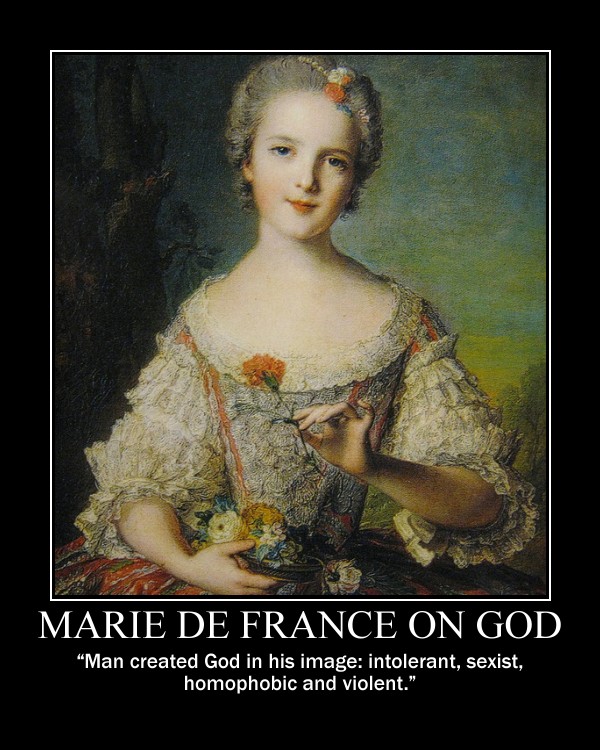
Marie De France
            
Image result for marie de france memes
(I saw this meme and thought that after all the we have read, it was pretty relevant lol!)


           Women in the majority of the stories that we have read have had to be cunning and calculating to ensure their survival. However, many of these women I feel entrap their male counterparts out of spite such as Guinevere does to Launfal because he turns her down and blatantly calls her ugly. I would like to focus on the women in Sir Launfal.

Promiscuous Queens seems to be a common thread through these stories. I kind of chuckle at the predicaments these women are able to entrap these men in. Guinevere blatantly asks Launfal to sleep with her, and for him to give her his love, and when he refuses, not only does that bait him into spilling his guts about his much fairer lady-friend, but also Guinevere takes this horribly and runs to Arthur. Of course Arthur wants Launfal’s head; he just called his wife ugly! This puts Launfal into even more of a pickle, if that’s even possible, because now Launfal is being ordered to identify his lover and we all know how his story ends.

The women in these stories are not only cunning and mischievous, but also educators of sorts. They help facilitate life lessons being learned by their male counterparts. Launfal learns to not only have a filter, especially when what you have to say may not be the nicest thing in the world, even though it may be true; he also learns that sometimes sugar coating, and kissing up to someone is better than being put on death row due to your inability to filter your verbal diarrhea. 

So… my questions to you folks are:

1)  Do you agree with my findings, and if not…PLEASE feel free to disagree!! I want your gut reactions as well as your reaction after taking a second to process. Have fun with this!! You can give examples of your own if you so choose!
2)  On the topic of sugar coating, those of you that know me well will know that sugar coating is not one my strong suites. However, do you think there is a time and place to sugar coat things and/or be more mindful of your words in Launfal’s case? Or do you think that Launfal was totally justified in saying what he said even though the repercussions of his actions were quite extreme?

3)  If you were Launfal, would you have done anything differently, and if so what would you have done differently? Keep in mind, we do know the ending…so you can use that to your advantage… i.e. would you ask someone to be standing around when Guinevere comes on to you? Would you expose her, and if so what would HER repercussions be? (Again have fun with this! Be creative and make your own twists and turns! I’m excited to see what you come up with!!!)

Tuesday, October 29, 2019

What the hell is the point?


Image result for dick dastardly

Never in my life have I read something (or heard of anything for that matter) so intricate, detailed and lengthy. As the book goes on we learn name after name and sin after sin of countless people. Dante seems to playing god as he describes which sins are  more dastardly (>>>>>>>>>). Which seems odd and a bit contradictory since one of his motives of "Inferno" seems to be to humiliate and tarnish the name of those who defy god.
This may be a stretch, but isn't he actually committing a sin by judging others when the one true judgement of people that matters comes from God? Let me know your thoughts on this.

Now for my main point, what is his motive for all of this?

Is he trying to entertain people by offering a description of what is perhaps one of the most mysterious and important circumstances of humanity?

Do you think that he truly believed that his depiction is exactly what hell is like?

Was he simply trying to further a political agenda by "exposing" all of the sins of his enemies and people who didn't share his beliefs?

A combination of things? Or something else? I look forward to reading y'all's ideas and explanations for this wacky and twisted masterpiece.
-Cam


Image result for dante's inferno